As the rich get richer and the poor get poorer, class warfare is only getting worse as millions of Americans struggle to make ends meet. Income inequality has led to more people falling below the poverty line and loosing hope of achieving the American dream, which seems to be harder to reach. Socialist politicians such as Democratic primary candidate Bernie Sanders, are using the anger and frustration of the failing middle class to gain momentum and push their political agenda as being the solution to strengthen the middle class.
Republican primary front runner Donald Trump is also taking advantage of the anger and frustration among the middle class, especially the poorly educated, he loves the poorly educated. By advertising himself as the man who can bring prosperity and growth to the middle class and bring jobs back from China and Mexico, his message appeals to many dissatisfied Americans who are suffering due to income inequality.
As the race continues, candidates are realizing that Americans are eager to elect a fresh face who has a plan and the ambition to bring prosperity to the middle class. Without a strong middle class, the United States is doomed to fail.
A blog for students of Canadian and World Politics (CPW4U), which explores the nature of politics: the good, the bad, and the ugly.
Welcome!
This blog is a forum by which you can learn about, discuss, and contribute to the political debates going on all around you. Here you can respond to the great - and terrible - ideas of the day. You can also respond to Mr. Peat's postings, post your own, and interact with each other. In short, become a class "citizen". As Churchill once said: Healthy citizens are the greatest asset any class can have - or something to that effect.
Canadian Political Websites
Friday, April 8, 2016
2016 Presidential Elections: Income Inequality

As of today, I do not think that income inequality has been a major issue discussed on the campaign trail. Republicans often think that those on the top of the income scale in America are justified for paying lower taxes as they are job creators.
The only place we have seen mentions of income inequality is in the Democratic party, particularly that of Bernie Sanders. Robert Reich has been a vocal supporter for Sanders plans, which include large tax hikes on the rich and the removal of tax loopholes to ensure that the top 1% of Americans pay there 'fair share'.
Hilary Clinton, a centrist in the political race, has been rather mute on the issue. She supports the Democratic parties stance on the minimum wage, and other similar socio-economic issues, but it is unclear if she would introduce substantial tax hikes.
In my opinion, the issue of income inequality will not present itself until the Democratic and Republican nominees have been selected, and I doubt that the Republican party will budge from their current 'job creators' platform of which they have held so dear for so long.
How Income Inequality Shaped the 2016 American Presidential Election
Twenty two months ahead of the 2016 presidential election, the nascent presidential campaign already has a leading issue, this issue would be the economies failure to produce rising incomes for the middle class. From WWII through the 1970's, all working Americans seemed to have seen their paycheques rise. American's unfortunately, in the middle of the income ladder are now earning less, adjusted for inflation, than they did in 2000. Even though economic growth has resumed, the stock market has soared into record territory and the number of Americans filing new claims for its unemployment benefits has fallen to its lowest level in nearly 15 years. The income seems to have been stuck except for those at the very top.
It is said from a poll that two thirds of Americans said they were dissatisfied with the way income and wealth are distributed in the U.S. Nearly 80% have said they're dissatisfied with the earning of $30,000 to $75,000. The dissatisfaction has now become significant in shaping the agendas of presidential hopefuls in both parties. The issue has moved democrats to the left, creating arguments in efforts of redistributing income way from some of the wealthiest Americans, in hopes of helping families who earn far less.
Both Obama and Hilary Clinton advocated increasing taxes on the inherited wealth to pay for tax cuts and wage supplements for middle class or lower income working families. "So much of the recovery...has gone to such a small segment of the population that now middle-class and upward-mobility stagnation has become more apparent".
Lately republicans have had an easier time identifying the problem than proposing solutions. Bush has said for an example, he would outline proposals in "coming weeks", even identifying the problem. GOP officials have argued Obama's policies should take the blame for stagnant wages, saying too much regulation and high taxes have stifled business growth and job creation. Yet for republicans, a credible plan for expanding middle class incomes may be a necessity for 2016.
Wednesday, March 9, 2016
Will China Dominate the 21st Century?
![]() |
| Pollution |
Will
China Dominate the 21st Century?
When
first looking at China, you take one look at its Economy and automatically
think that it’s among those countries dominating the 21st century. It is a given that the Chinese economy is
among the largest in the world. It has
been noted that in the first decide of the 21st century, its economy
has grown one-eighth the size of the U.S. economy to more than one-half. Despite
showing signs of slowing down, by going from a 10% growth rate and decreasing
to a 7% growth rate, the Chinese economy significantly surpasses the United
States as the largest economy.
However,
despite this constant flow of economic success, there are many other challenges
that they do indeed face. For instance, environmental degradation, which will
enviably be expensive to clean up has proven to be among the biggest issues the
country faces. Also, they’re demographic challenges are unique, as its labor
force has already peaked, and fertility rates are shrinking meaning that its
population will shrink in the next 15 or so years. Not only this, but the
country still lacks an independent judiciary and an independent media, which is
among other human rights issues that the country still faces.
It
is also known that there is a massive imbalance in equality and living
standards, there is a massive concern for quality of life i.e. the citizens
having to wear face masks, and the country’s unnerving percent of undrinkable
water and also a massive concern for its Agriculture or lack there of. The
government faces the challenge that is feeding their 1.3 billion populations
with a significant increase of unusable and polluted land.
![]() |
| Declining Fertility Rate |
With
theses challenges, I do believe that China will not dominate the 21st
century as I see that the bad do in fact out way the good. At the present time,
there are far too many challenges that the country faces that would enable this
developing country to dominate the 21st century. Yes, it economy
does prove far superior to many other western civilization, but I do believe
that if a country is to dominate, the Economy along with the a countries demographic, its agriculture , the quality of life and the
environment must equally prove superior to other countries.
Monday, March 7, 2016
China Doesn't Have What It Takes
Since the dawn of the 21st century, intellectuals, policymakers and laymen alike have endeavoured to identify who the new global superpower will be. The consensus among many is that China will dominate this century, much like America did the last and the United Kingdom the century before that. Adherents to the theory of Chinese supremacy point to its robust economy, its massive population and even its tightly controlled political structure. Nevertheless, as appealing as it may be, there are several genuine issues with the assumption that China will surpass all others in the near future.
First off, China possesses a nightmarish government, rife with corruption and bureaucracy and all too keen on repressing its people. Its ruling Communist Party is nothing more than a cult with an iron grip on Chinese citizens; though the country is gradually shifting away from economic communism, it is still very much enamoured with other aspects of the system. If China were to ever abandon communism, it would be due to and result in massive unrest and upheaval. As well, many of its autonomous regions and special administrative regions could feasibly declare independence. On the world stage, China is completely disinterested in leading and prefers to sit back while other powerful countries discuss the pertinent problems of the day. China may have a multitude of financial allies but possesses few solid, influential political ones. The USA's military spending dwarfs China's and the lack of innovation in the latter country extends to the field of military technology.
Demographically, China is not in an enviable position. With low fertility rates and an aging society, China's population is expected to decrease dramatically in the coming decades. China is already experiencing a number of issues with its current pension obligations, which a large portion of municipalities are incapable of paying. Its contracting population will have a severe affect on its workforce; namely, an eleven percent decrease in working age population by 2050. Consequently, China may have to begin importing workers and will certainly no longer be the cheap labour capital of the world.
Although various facets of Chinese culture, such as kung fu, are recognizable across the world, China punches far below its weight in terms of cultural influence. Its brands have a reputation for unreliability and its literature, pop music and sport have marginal to no impact in other countries. Its neighbours Japan and South Korea are far more valuable culturally, as are others not nearly as potent economically, including Italy and France.
When China's GDP is broken down into its separate components, it is revealed that 70% of it is directly associated with infrastructure spending. Entire cities are built to satisfy the government's insatiable desire to inflate economic indicators, even if the methods by which these augmentations occur are purposeless. Additionally, China is sitting atop a mountain of undiscovered debt, as all levels of government borrow enormous amounts of money to finance these infrastructure ventures. On a different note, China, possessing a largely state-controlled economy, does not have the ability to reinvigorate itself following the collapse of vital industries. Possible economic transformation would develop amidst a backdrop of widespread discord amongst the populace.
The rise of the Chinese economy is driven by the consumption of coal, a substance that has environmentally disastrous affects when burned. It would be exceedingly burdensome for China to replace coal as its primary source of fuel, since the majority of local economies are dependent on heavy industry. In turn, these industries are sustained by coal. Predominately thanks to its coal usage, China faces myriad environmental concerns that its government has taken no initiative to concretely address.
As much as China appears destined to become the world's newest superpower, careful consideration of facts and statistics proves that this assumption is erroneous. China, despite its perceived economic might, does not have what it takes to surpass America as the global, hegemonic leader. Sinophiles may be convinced, however, those who are not blinded by their adoration for China should not fall for this well-cultivated myth. To be fair, I do not know for certain who will dominate the 21st century but I am thoroughly confident that it will not be China.
Links: http://www.scmp.com/comment/article/1463940/asias-economic-rise-doesnt-mean-it-will-own-21st-century
http://www.businessinsider.com/5-reasons-china-wont-take-over-the-world-2013-1
First off, China possesses a nightmarish government, rife with corruption and bureaucracy and all too keen on repressing its people. Its ruling Communist Party is nothing more than a cult with an iron grip on Chinese citizens; though the country is gradually shifting away from economic communism, it is still very much enamoured with other aspects of the system. If China were to ever abandon communism, it would be due to and result in massive unrest and upheaval. As well, many of its autonomous regions and special administrative regions could feasibly declare independence. On the world stage, China is completely disinterested in leading and prefers to sit back while other powerful countries discuss the pertinent problems of the day. China may have a multitude of financial allies but possesses few solid, influential political ones. The USA's military spending dwarfs China's and the lack of innovation in the latter country extends to the field of military technology.
Demographically, China is not in an enviable position. With low fertility rates and an aging society, China's population is expected to decrease dramatically in the coming decades. China is already experiencing a number of issues with its current pension obligations, which a large portion of municipalities are incapable of paying. Its contracting population will have a severe affect on its workforce; namely, an eleven percent decrease in working age population by 2050. Consequently, China may have to begin importing workers and will certainly no longer be the cheap labour capital of the world.
Although various facets of Chinese culture, such as kung fu, are recognizable across the world, China punches far below its weight in terms of cultural influence. Its brands have a reputation for unreliability and its literature, pop music and sport have marginal to no impact in other countries. Its neighbours Japan and South Korea are far more valuable culturally, as are others not nearly as potent economically, including Italy and France.
When China's GDP is broken down into its separate components, it is revealed that 70% of it is directly associated with infrastructure spending. Entire cities are built to satisfy the government's insatiable desire to inflate economic indicators, even if the methods by which these augmentations occur are purposeless. Additionally, China is sitting atop a mountain of undiscovered debt, as all levels of government borrow enormous amounts of money to finance these infrastructure ventures. On a different note, China, possessing a largely state-controlled economy, does not have the ability to reinvigorate itself following the collapse of vital industries. Possible economic transformation would develop amidst a backdrop of widespread discord amongst the populace.
The rise of the Chinese economy is driven by the consumption of coal, a substance that has environmentally disastrous affects when burned. It would be exceedingly burdensome for China to replace coal as its primary source of fuel, since the majority of local economies are dependent on heavy industry. In turn, these industries are sustained by coal. Predominately thanks to its coal usage, China faces myriad environmental concerns that its government has taken no initiative to concretely address.
As much as China appears destined to become the world's newest superpower, careful consideration of facts and statistics proves that this assumption is erroneous. China, despite its perceived economic might, does not have what it takes to surpass America as the global, hegemonic leader. Sinophiles may be convinced, however, those who are not blinded by their adoration for China should not fall for this well-cultivated myth. To be fair, I do not know for certain who will dominate the 21st century but I am thoroughly confident that it will not be China.
Links: http://www.scmp.com/comment/article/1463940/asias-economic-rise-doesnt-mean-it-will-own-21st-century
http://www.businessinsider.com/5-reasons-china-wont-take-over-the-world-2013-1
![]() |
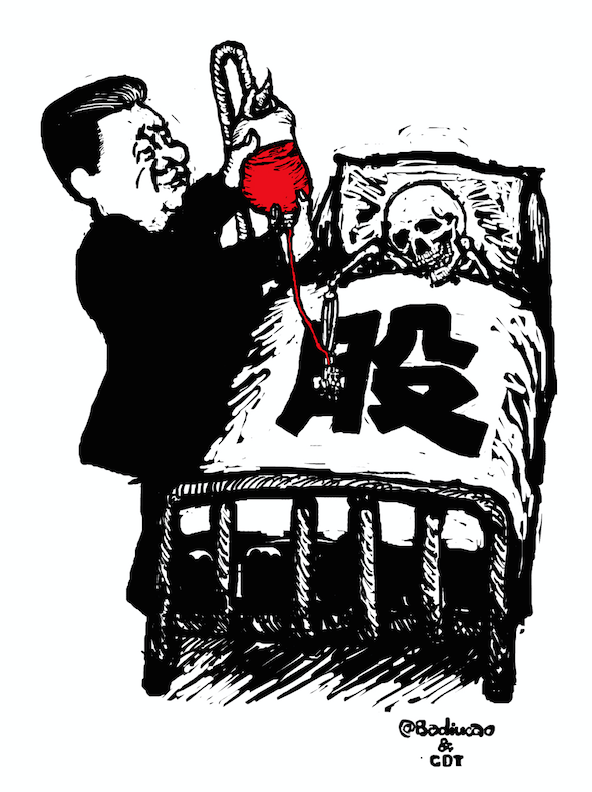
Bleeding Out: China Edition
Image Source: Cartoonist Badiucao
According to a report from the Institute of International Finance, an estimated $676 billion dollars left China in 2015. The report continues, asserting that as overseas investors grow increasingly wary of the country's slowing economic growth, the region will see even larger capital outflows of much needed foreign currency. In response to internal bleeding concerns, China instituted a limit of $50,000 on the amount of money an individual can move out of the country in a given year. This restriction calls into question not only an individual's lack of civil liberties, right to self-betterment, and economic freedom, but the well-being of the economy as a whole. Without external investment to make up for this loss, the Chinese economy will be dead in it's tracks.
In order for China to deliver on a world stage, it must first address its domestic situation. It remains one of only a few countries in the world with governing communist principles; restricting its economic growth. The way I see it, China is like a balloon with a pin hole. No matter how much air you blow into it, it will still drain out slowly over time. The air represents the Chinese government's desperate attempt at falsely pushing up the economy, while the pin hole represents its communist values, the outflow of capital, and environmental degradation.
In conclusion, because of China's perilous domestic situation, the outflow of foreign capital, and the environmental degradation concerns, it will not reign strong in the 21st century.
Image Source: Cartoonist Dave Granlund
Bibliography:
Yan, Sophia. "China Hemorrhaged $676 Billion Last Year. CNNMoney. Cable News Network, 21 Jan. 2016. Web. 04 Mar. 2016
Sunday, March 6, 2016
China: The Diamond in the Rough
In recent months, economic news coming out of China has been less than ideal for investors, causing global economic uncertainty as there is a a growing fear that the world's second largest economy may crash. This fear has been generated due to economic data revealing that China's industrial sector is shrinking and overall gross domestic product (GDP) is decreasing. Amidst the economic doom and gloom portrayed by the media, there is another side to the story and it paints a different picture.
For decades, China's economic health has been measured by the Li Keqiang Index, which represents all of the country's credit growth, energy consumption, and freight transport volumes. The Index reflects the old way China's economy functioned: factories, cheaply funded state-controlled banks, goods produced by massively consuming electricity, and shipping products on the international market. Today, China's economy is highly diversified and the aforementioned economic measures are outdated and poorly reflect the overall health of the country's economy.
The service sector in China has been steadily growing and from January to November of last year. China registered 3.9 million new companies, mostly in tourism, health care, sports, and education. Additionally, wages are increasing and millions of people are being lifted out of poverty and into the middle class every year. All of these indicators show that China's economy is currently moving into a different phase and in the process of diversifying in order to become the largest economy in the world.
Although many western media outlets characterize China as a faltering country on the verge of collapsing and potentially taking the entire world with it, this is truly a misrepresentation of reality. Currently, China is governed by a communist government and there are concerns that it is loosing its grip on its citizens, but as the standard of living improves, wages increase, and more freedoms are introduced, the people of China will be disinterested in a change in government. Overall, China is a powerful country that is quickly developing and growing at unprecedented speeds and regardless of what short-term numbers reveal, the country is moving in a trajectory that includes economic prosperity and political might. China will be the next superpower of the 21st century.
Link to news article
.
Link to news article
.
Subscribe to:
Posts (Atom)